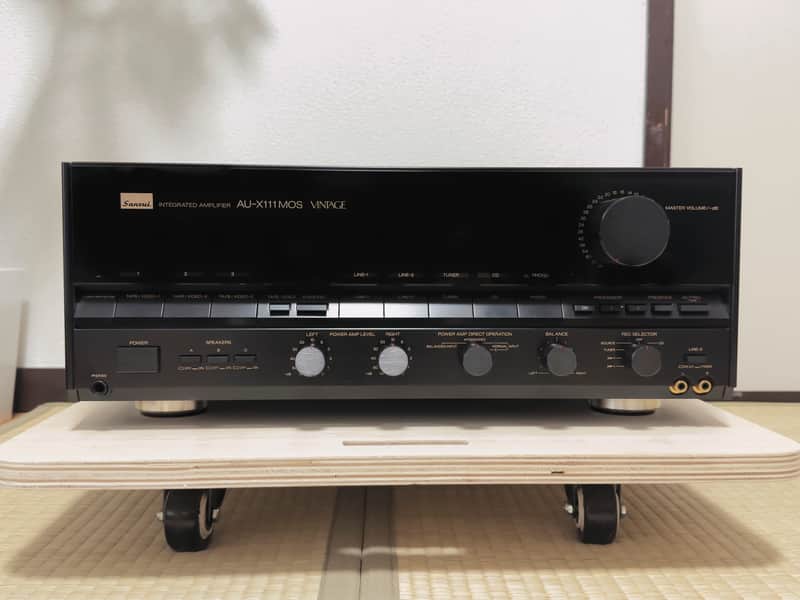
Prologue: This SANSUI AU-X111 MOS VINTAGE (JDM / Japan Domestic Market model at 100V) has been carefully restored here in Fukuoka, Japan by takumi (artisans) — former Sansui technicians who understand not only how the amplifier works but why it was made this way. Each component is examined, adjusted, and returned to harmony, preserving the original voice and balance envisioned by Sansui. Nothing is rushed. Nothing is excessive.This entire restoration work takes two to three months, allowing the amplifier to settle naturally, as it should. What remains is not merely an amplifier, but a piece of Japanese monozukuri—quiet, enduring, and made to be lived with.It will reward its owner with many unhurried hours of listening, where music is allowed to breathe.The Ultimate Expression of Master-Quality Audio Engineering (1985)Introduction: A Legend in Copper and RosewoodThe Sansui AU-X111 MOS Vintage is not merely an amplifier; it is a "Statement Piece" from the Golden Era of Japanese Hi-Fi. Released in 1985 at a staggering price of ¥330,000, it was engineered by the legendary Ichiro Ohshima with a singular goal: to recreate the soulful, harmonic richness of the classic AU-111 tube amplifier using the precision of modern Solid State technology.Sitting at the very pinnacle of the "Vintage" series, the AU-X111 is often compared to the later AU-α907i MOS Limited. However, the AU-X111 is the purist’s choice, featuring a massive overbuilt chassis, real rosewood side panels, and a internal architecture that prioritizes signal purity over all else.Background Story (the development of the X111 MOS Vintage amplifier)The "Return to the Roots" MissionBy the early 1980s, Sansui was struggling. They had shifted toward mass-market products to compete with giants like Sony and Technics, and their reputation for "high-end" audio was slipping.Ichiro Ohshima, a young and brilliant engineer, was a massive fan of Sansui’s original 1965 masterpiece, the AU-111 (Tube Amplifier). He famously stated that he joined the company because he loved the sound of the AU-111 paired with JBL speakers. His lifelong goal was to recreate that warm, musical, "vacuum tube" soul using modern solid-state technology.The Significance of the "111" NameIn Sansui's naming convention, the number "07" was for their mainstream high-end (the α907 series), and "X1" was for their flagship line. However, Ohshima specifically resurrected the "111" designation for the AU-X111 MOS Vintage to signal to the world that this was the spiritual successor to the original tube AU-111. It wasn't just a model number; it was a manifesto. It was his first project as a product manager where he was given the freedom to build an amplifier "without compromise."The "Balanced" ObsessionThe AU-X111 was the first integrated amplifier to truly perfect the X-Balanced Circuit that Ohshima championed.The Problem: In the mid-80s, CD players were introducing digital "noise" into the ground line of amplifiers.The Ohshima Solution: He designed the AU-X111 as a "Balanced" amplifier from input to output. This meant the signal was never "referenced" to the ground, effectively floating it away from the digital noise. This is why the AU-X111 has such an incredibly "black" (silent) background compared to other amps of that era.The "MOS" Choice: Ohshima chose MOS-FETs specifically because they mimicked the "square law" characteristics of vacuum tubes. The AU-X111 was his first massive-scale implementation of this philosophy.The "Shower Light" Aesthetic: The AU-X111 introduced the famous "Shower Light"—a soft, indirect glow that illuminates the controls from above. Ohshima wanted the amplifier to look as warm as it sounded, moving away from the cold, industrial look of 70s gear.Power amplifier sectionType: Master control integrated amplifier.Rated power output (10 Hz – 20 kHz, both channels):150 W + 150 W (6 Ω).110 W + 110 W (8 Ω).Dynamic power:320 W + 320 W (2 Ω).240 W + 240 W (4 Ω).190 W + 190 W (6 Ω).THD (10 Hz – 20 kHz, at rated output, 8 Ω): 0.008%.IMD (SMPTE 60 Hz:7 kHz = 4:1, 8 Ω): 0.008%.Damping factor: 200 (8 Ω).Frequency response (1 W): DC – 300 kHz, +0 / –3 dB.Input sensitivity / impedance (power amp in): 1 V / 2 kΩ (1 kHz).S/N (A‑weighted): ≥115 dB (power amp section).Slew rate: ±150 V/µs (8 Ω).Rise time: 0.5 µs.Headphone output: 150 mW (33 Ω).Load impedance: 4–16 Ω.Preamplifier sectionPhono MM input sensitivity / impedance: 2.0 mV / 47 kΩ (1 kHz).Line inputs (Tuner, CD, Tape Play 1–3, Line 1–2) sensitivity / impedance: 150 mV / 47 kΩ (1 kHz).Maximum input level, Phono MM: 270 mV (1 kHz).Tape Rec output: 150 mV / 47 kΩ, output impedance 600 Ω or less.S/N (A‑weighted): Phono MM ≥88 dB; line inputs ≥110 dBSubsonic filter: 16 Hz (–3 dB, 6 dB/oct).Presence (at –40 dB volume): +2 dB at 200 Hz.Audio muting: –20 dB.GeneralRated power consumption: 350 W (per Electrical Appliance and Material Control Law).Dimensions (W×H×D): 450 × 176 × 486 mm.Weight: 32.1 kg.Mains voltage (domestic Japanese version): 100 V, 50/60 Hz; step‑down transformer required in 220–240 VCondition Overview: This SANSUI AU-X111 MOS VINTAGE (Japan Domestic Model) has been meticulously cleaned and restored, both inside and out, by our Takumi (Master Craftsmen), who carried out a complete overhaul. Since its return, it has been put through 2 weeks of testing by us at Vintage Japan HiFi. Cosmetic Condition: 9.0/10 – More than exceptional overall ! The front panel is exceptionally clean with very little visible hairline scratches The back panel shows some minor scratches which is expected from its age but does not affect its performance. All the gold RCA connectors polished by our master craftsmen at the workshop. The system A speaker connectors have been upgraded to modern version.The rosewood panels are clean with very little visible scratches.Performance: 9.5/10 – Operating at peak specifications after full service by our ex-Sansui engineers. Sonic characteristics : powerful yet controlled presentation, smooth grain-free treble, natural and slightly warm midrange, wide sound stage with strong image stability and effortless dynamics.