BETA
RADAR is in beta — expect errors. Accuracy and coverage improvements are shipping daily.
LIVE
Waiting for new listings…
0 other audiophiles online

Seller's Description

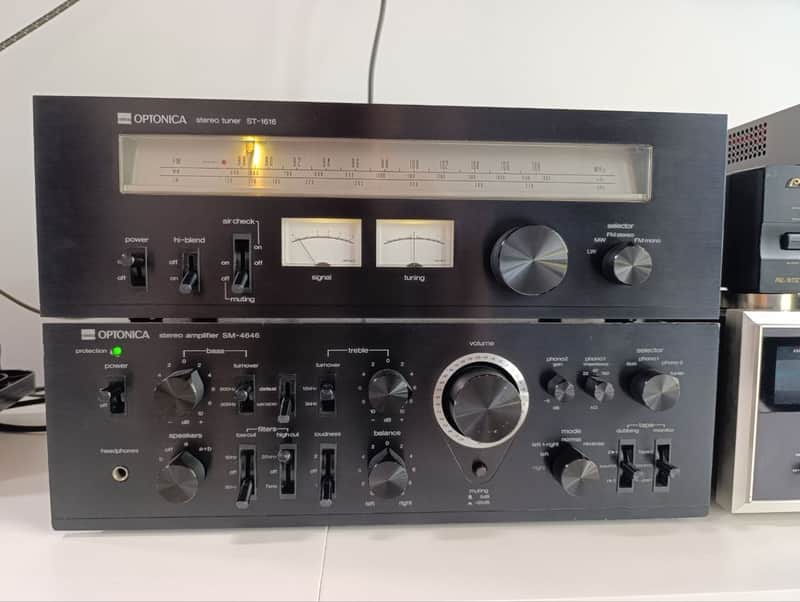
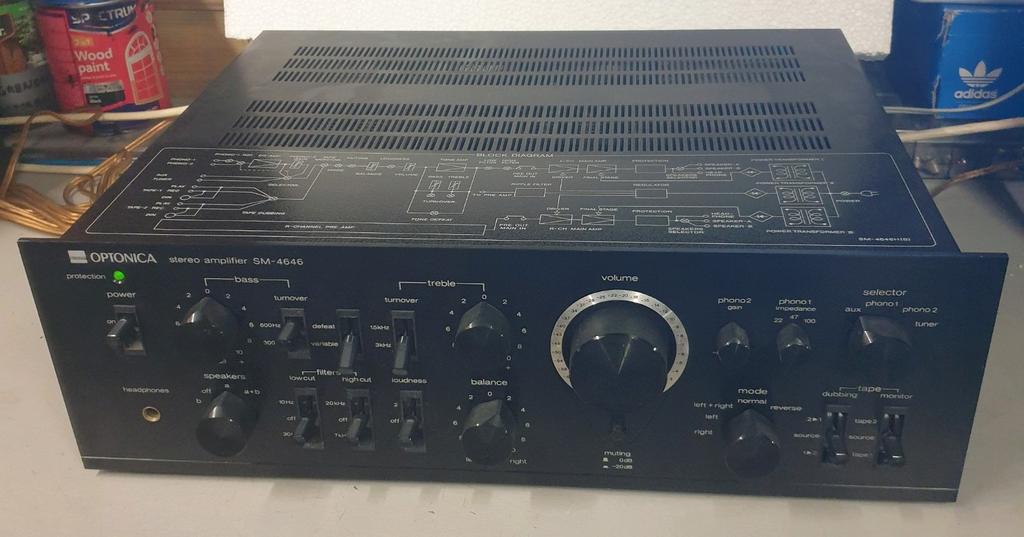
Sharp Optonica SM‑4646 — the flagship amplifierThe SM‑4646 was a true powerhouse for its time: the absolute top‑of‑the‑line model of the Optonica series, built with an almost audiophile philosophy by the standards of the era. It features three dedicated transformers (“Delta Power”): one reserved for the pure Class‑A pre/driver stage, and two independent ones — one per channel — for the output stages in a dual‑mono configuration, ensuring maximum channel separation and stability.Power output: 70W + 70W RMS into 8Ω, up to 90W of peak musical power. Damping factor: above 50, for precise loudspeaker control. Volume control: 4‑section attenuator (“4‑gang”), a superior solution compared to standard potentiometers. Pre/power section: separable.It was awarded the French Laurier d’Or at the time for functionality, design, and performance. A rare and sought‑after piece — unsurprisingly: limited production and the demanding construction (three transformers instead of the usual single one) make it hard to find today, especially in conditions like these.Specialized magazines of the late ’70s (such as HiFi Jahrbuch, Audio, Stereo Review, Radio Electronics) reported that:The Optonica SM‑4646 was considered superior to the average Pioneer integrated amplifiers in the same price range, especially thanks to:dual‑mono power supply with 3 transformers,Class‑A preamp section,advanced phono stage,very high real‑world power output,16 kg build quality.Comparative tests of the time placed it in the high‑end segment, often above more commercial models from Pioneer, Kenwood, and Sony. Some magazines described it as an “underrated top performer”, penalized only by the limited market presence of the Optonica brand.Therefore, what I’m offering is a rare and desirable piece — not by chance: limited production and the demanding construction (three transformers instead of the standard single one) make it difficult to find today, especially in conditions like these.Preferably sold together with the ST‑1616 tuner, which you can find in my other listing. Why buy them together: the SM‑4646 amplifier is a model that is hard to find on the market, especially in cosmetic and functional condition like this. The amplifier + tuner pair is already matched both aesthetically and functionally, making it ideal for anyone who wants to recreate a coherent vintage hi‑fi setup without having to search for individual components. If purchased together, I’m open to considering offers.Perfect working order, checked by a technician, used daily without any issues. It shows only normal signs of age, fully consistent with the piece’s vintage.

Our Thoughts RADAR AI

Generating expert take…

About Optonica

# Optonica

Optonica was a high-end audio subdivision of Sharp Corporation, the Japanese electronics manufacturer. Launched in 1975 (with some sources citing 1976), the brand was created to compete directly with established premium audio makers including Pioneer, Yamaha, Sansui, Nakamichi, and Marantz during the golden age of hi-fi. Sharp designed, built, and marketed Optonica products entirely in Japan, positioning the line as a serious contender in the luxury stereo market.

The brand's product portfolio centered on integrated amplifiers, receivers, and complete stereo systems aimed at discerning audiophiles. Optonica equipment was engineered to deliver high-fidelity sound reproduction across the mid-to-high power range, with models typically rated between 40 and 60 watts per channel. The brand maintained a focused approach, concentrating on core audio components rather than diversifying across numerous product categories.

Optonica's tenure in the high-end audio market proved relatively brief, effectively ending by 1982 as a serious competitor. The brand was revived in 1988 as a consumer electronics line encompassing stereo television receivers, VCRs, portable cassette players, and surround-sound receivers, but this iteration lacked the prestige of the original audio division. Production ceased entirely by 1991. Today, Optonica equipment from the late 1970s and early 1980s holds appeal among vintage audio collectors and enthusiasts seeking well-engineered Japanese hi-fi from that era.


See all Optonica listings on RADAR.

More SM-4646 listings