BETA
RADAR is in beta — expect errors. Accuracy and coverage improvements are shipping daily.
LIVE
Waiting for new listings…
0 other audiophiles online

Seller's Description

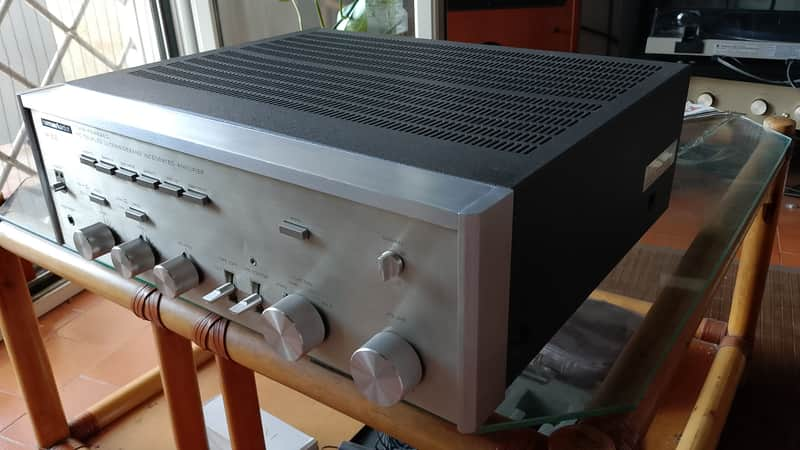
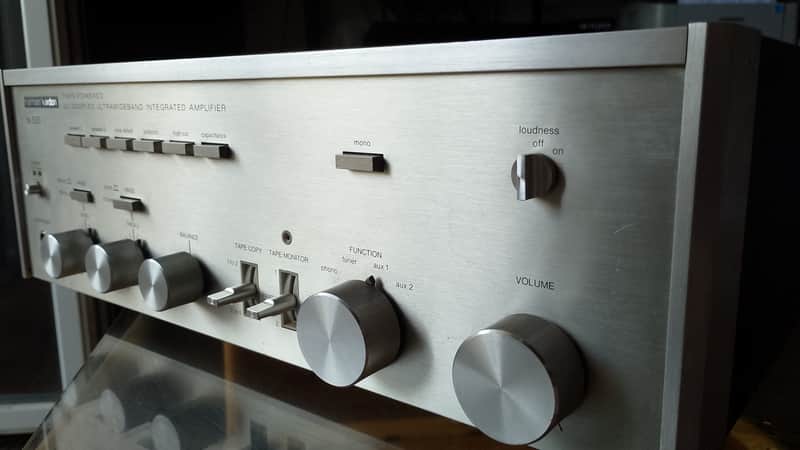
In excellent aesthetic and functional conditions. Pre and final separation, excellent phono section, built with first-rate materials and components. Designed in the USA, made in Japan, the HK 505 was the top of the line H/K when it was launched in 1978. * Twin Power Ultrawideband DC True Power design * High current Twin Core power supply (same type used in vintage high-end Marantz - 2285B, etc.) * 40,000mF filter capacitance * TO-3 discrete output transistors in rugged metal case * Stable into 4 ohms * 5 to 150,000 Hertz * 0.03 THD/IMD at full power, typically much lower * Preamp/Poweramp sockets * 13.6kg * Aux1, Aux2, Tape1, Tape2, Tuner, Phono * Speaker 1, Speaker 2; switchable * Tone mute * Tone controls with tone inversion * Subsonic filter, high-pass filter, mono selector * Phono capacitance selector * Balance, volume * Tape copy 1 and 2, Tape monitor 1 and 2 * Loudness selector *

Our Thoughts RADAR AI

This is a deal: at US$392, it lands below the US$403 25th percentile and well under the US$414 median of the recent comps. For a vintage integrated amp, that puts it in bargain territory rather than merely fair, assuming the unit is operational and not missing anything major.

What makes it worth a look is the usual HK appeal: these were built as straightforward, musical, no-nonsense integrated amps with enough current on tap to sound open and composed on sensible speakers. At this price, the upside is strong if the faceplate is clean and it powers up quietly, because even modest service costs can still leave room versus the market. The main thing to verify is basic health—scratchy controls, relay delay, channel balance, and any service history.

Independent perspective — not a price guarantee. Always verify condition, accessories and provenance before purchase.

About Harman Kardon

Harman Kardon traces its origins to 1953, when Dr. Sidney Harman and Bernard Kardon, both engineers frustrated with conservative audio manufacturing at the David Bogen Company, invested $5,000 each to launch their venture in Westbury, New York. Their debut product, the Festival D1000, became the world's first compact AM/FM hi-fi receiver, blending breakthrough technology with sleek design to make high-fidelity sound accessible beyond technical enthusiasts. Pioneering innovations like the 1958 Festival TA230 stereo receiver, the 1959 Citation II ultra-wide bandwidth tube amplifier, and the 1970 CAD5 hi-fi cassette recorder with Dolby noise reduction cemented their legacy in simplifying premium audio for the home.

The brand focuses on integrated receivers, amplifiers, tuners, and speakers that emphasize performance, reliability, and elegant industrial design. Over decades, it expanded into home theater systems and automotive audio, powering systems in vehicles from Land Rover and BMW to Volvo and Polestar. While not delving into turntables, DACs, headphones, or cables, Harman Kardon prioritizes cohesive hi-fi components that deliver warm, detailed sound without unnecessary complexity.

Harman Kardon holds a solid mid-tier position in the hi-fi market, renowned among knowledgeable buyers for its enduring quality and value rather than ultra-high-end exotica or vintage collector status. Now part of Harman International, it appeals to discerning listeners seeking dependable, stylish gear that echoes its innovative heritage without commanding boutique premiums.


See all Harman Kardon listings on RADAR.

More HK 505 listings