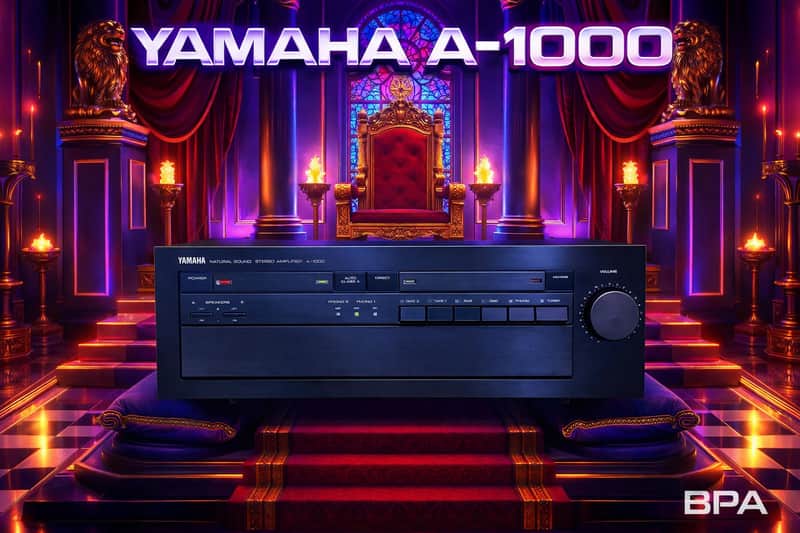
Yamaha A-1000 1985 - Black anodized
- Location
- US
- Source
- Reverb
- Posted
- 8 Aug 2026
- Last seen
- 2d ago
RADAR is a price search engine. We link to the original listing — we never sell direct. Transactions happen on the source site.
Superb condition. Caustic glue has been removed and neutralize. No issues with offset or any other functions. Unit has been cleaned, pots lubricated and test for several hour. Great for phono use with Class A sound Before Yamaha chased remote controls and touchscreens, they built machines like this. The A-1000 was Yamaha’s top-of-the-line integrated amplifier, delivering 120 watts per channel into 8 ohms and over 200 watts per channel into 4 ohms — numbers that still humble most modern integrateds.Pop the front door and you’ll find a switchable amplifier class between AB and Auto Class A, with the amp running pure Class A up to 10 watts of output — the same warm, holographic sound that made Class A designs cult favorites, without the electric bill of a full-time Class A monster. Powering all of it is a power supply so overbuilt it borders on excessive: a hyperfractionated multi-terminal power supply with a total capacitance of 146,000 microfarads, feeding a preamp and power amp section that run on entirely separate power rails.This isn’t a stripped-down receiver wearing an amp’s clothes. It’s got Yamaha’s signature “Richness” tone-shaping circuit, dual phono inputs for moving coil and moving magnet cartridges, and a build quality that owners are still bragging about decades later.• Black-panel Natural Sound flagship integrated• Auto Class A / Class AB switchable• Massive dual-capacitor power supply• Dual phono inputs (MC/MM)• Fully serviced, tested, and ready to power a real speaker systemIf you know, you know. This was the amp Yamaha built when they weren’t cutting corners — heavy, honest, and still delivering more current than most modern gear twice its price.
This is a buyer's market at the moment: at US$775, the asking price lands right on the median of recent comparable listings, so it reads as fair rather than a bargain or an ambitious ask. With the 25th percentile at US$417 and the 75th at US$875, this is squarely mid-pack pricing for the model.
That makes sense for a Yamaha integrated from the company’s better-regarded vintage era: these are typically valued for solid build, a mature, listenable presentation, and enough power/current to make them genuinely useful with real speakers. At this price, the appeal is in getting a respected classic at market rate; the main buyer focus should be condition, service history, and whether the unit is cleanly functioning, since age-related wear is where value can swing most.
Independent perspective — not a price guarantee. Always verify condition, accessories and provenance before purchase.
Yamaha stands as one of the world's most storied audio manufacturers, with roots extending far beyond consumer electronics. Founded in 1887 by Torakusu Yamaha in Hamamatsu, Japan, the company began as a reed organ manufacturer before expanding into pianos and eventually becoming a comprehensive musical instrument maker. This deep heritage in acoustics and materials science would prove foundational to its later audio ventures. The company operated under its original name, Nippon Gakki Co., Ltd., until 1987, when it was renamed Yamaha Corporation in honor of its centennial.
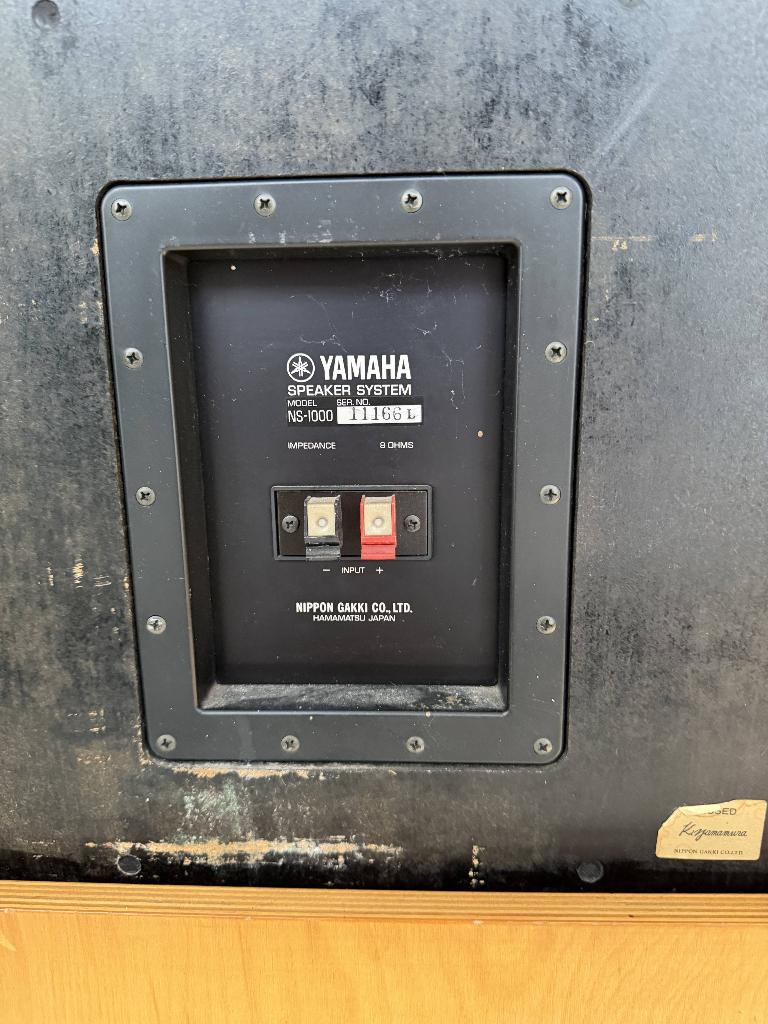
Yamaha's entry into high-fidelity audio proved transformative for the industry itself. In 1954, the company released the Yamaha Hi-Fi Player, widely recognized as the world's first audio component to bear the "Hi-Fi" designation in its name. The company subsequently built a comprehensive product portfolio spanning amplifiers—beginning with the acclaimed A-100 in 1960—speakers, turntables, and digital audio equipment. The NS-1000 speakers, introduced in 1974 with beryllium drivers, became iconic reference monitors. Yamaha also pioneered digital audio technology, shipping the world's first CD recorder in 1988.
Today, Yamaha occupies a distinctive position as a mid-to-high-end generalist rather than a niche specialist. The brand commands respect among both casual listeners and serious audiophiles, balancing accessibility with genuine engineering credibility. Its reputation rests on six decades of consistent innovation, proven reliability, and the unique advantage of applying musical instrument expertise to audio reproduction. Vintage Yamaha components remain highly sought by collectors, while current products maintain the brand's tradition of delivering performance and durability across multiple price tiers.

See all Yamaha listings on RADAR.