BETA
RADAR is in beta — expect errors. Accuracy and coverage improvements are shipping daily.
LIVE
Waiting for new listings…
0 other audiophiles online
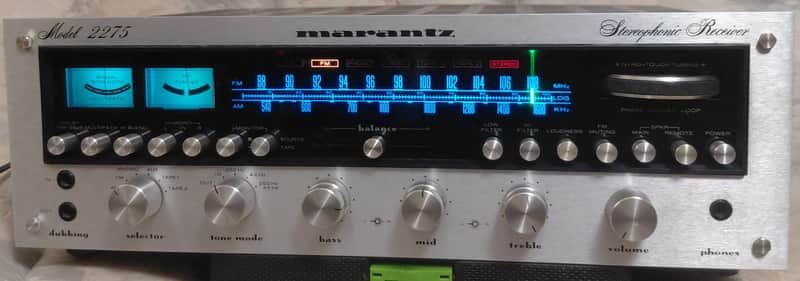
Marantz Model 2275 75-Watt Stereo Solid-State Receiver 1974 - 1977 -Fully Restored Silver with simulated woodgrain vinyl cover
Other Marantz 1974-1977 4 views

Marantz Model 2275 75-Watt Stereo Solid-State Receiver 1974 - 1977 -Fully Restored Silver with simulated woodgrain vinyl cover

USD$3,000
Location
US
Source
Reverb
Posted
15 Aug 2026
Last seen
2d ago

RADAR is a price search engine. We link to the original listing — we never sell direct. Transactions happen on the source site.

Seller's Description

Up for sale Fully Restored Marantz 2275 Receiver. This receiver is not just a recap it has been fully restored. All boards have been thoroughly gone through and tested. Receiver has had new velum and warm white frosted LED fuse lamps. All function lamps are original Bi-Pin incandescent type, pointer has LED installed. All switches have been flushed and checked for proper actuation this also includes volume, balance, tone potentiometers. Receiver has had all input ad output functions tested and was burned in no less then 72 hours running an 8Ω load. I'm offering a 1 year warranty and free shipping to the lower 48 states. Receiver will double boxed with Styrofoam walls on all sides in both boxes and receiver will be encased in a full Styrofoam surround and bubble wrapped. If any further information is needed please don't hesitate to message me.What was done:Power Supply:8 capacitors (Nichicon PW, Panasonic FC)7 transistors (Fairchild/Onsemi)5 diodes (2 dual diodes, 2 zener diodes)1 Relay (Omron)P700 Amp:6 capacitors (Nichicon KL)8 transistors (Fairchild/Onsemi, two are HFE-matched pairs)8 diodesPE01 tone board:15 capacitors (Nichicon PW, Nichicon Muse, Wima film, Panasonic film)4 transistors (Fairchild/Onsemi)PS01 switch board:5 capacitors (Nichicon KL)P400 Phono EQ board:7 capacitors (Nichicon PW, Nichicon Muse, Panasonic film)6 transistors (Fairchild/Onsemi)2 diodes1 double diode (to replace the VD1212)P200 FM IF board:16 capacitors (Nichicon PW, Wima film)P300 FM MPX board:18 capacitors (Nichicon PW, Wima film)PC01 Dolby board:4 capacitors (Wima film)P150 AM tuner board:7 capacitors (Nichicon PW, Wima film)2 new main capacitors (Panasonic Made in USA 15000 uf 100v, same diameter as the old ones)Specifications:Tuning range: FM, MWPower output: 75 watts per channel into 8Ω (stereo)Frequency response: 20Hz to 20kHzTotal harmonic distortion: 0.25%Damping factor: 60Input sensitivity: 1.8mV (MM), 180mV (line)Signal to noise ratio: 82dB (line)Output: 1V (Pre out)Dimensions: 439 x 137 x 366mmWeight: 17.7kgYear: 1975

Our Thoughts RADAR AI

What exactly is it—receiver, integrated amp, or something else in that 1974–1977 Marantz window? At US$3,000, this is ambitious unless it’s a top-tier, fully restored piece with unusually strong provenance or a rare variant; typical used Marantz pricing for mainstream 1970s receivers and integrateds is usually well below that, with even desirable models often landing closer to the low-to-mid four figures or less.

The upside is obvious if the unit is one of the prettier silver-face classics: great build, strong tuner sections on the receivers, and the kind of warm, lively presentation people buy Marantz for. If it’s clean, original, and serviced, that matters a lot—but at this price I’d want exact model identification, restoration details, and proof of function before calling it a buy. Without that, it reads more like a collector’s ask than a straightforward enthusiast deal.

Independent perspective — not a price guarantee. Always verify condition, accessories and provenance before purchase.

About Marantz

Marantz originated in the United States, founded in 1953 by Saul Bernard Marantz, a music enthusiast and amateur musician born in Brooklyn in 1911. Dissatisfied with the audio equipment of the era, he crafted the groundbreaking Audio Consolette preamplifier in 1952 from his New York home, selling the first 100 units rapidly and prompting the formal establishment of the company in Woodside, Queens. Though production later shifted to Japan in partnership with manufacturers like Standard Radio in 1966, and the brand evolved through ownership changes including Superscope and eventual integration into larger groups, its heritage remains rooted in American ingenuity and a relentless pursuit of musical fidelity.

The brand excels in high-end audio components, particularly amplifiers, preamplifiers, and integrated systems that defined its golden era. Iconic models like the Model 7 preamplifier (1958), Model 9 power amplifier (1960), and Model 10B tuner (1964) set benchmarks for performance, while later offerings expanded to tuners, receivers, and CD players. Marantz briefly ventured into speakers under designer Ed May in the 1970s but focused primarily on electronics rather than turntables, headphones, DACs, or cables, emphasizing separates renowned for their "Most Musical Sound."

Marantz commands a premium position in the hi-fi market, revered as a high-end pioneer that shaped the audiophile landscape through the 1970s zenith. Today, it blends vintage allure with modern elegance, appealing to discerning buyers who value durability, innovation, and warm, detailed sound signatures over mass-market accessibility.


See all Marantz listings on RADAR.

More 1974-1977 listings