LIVE
Waiting for new listings…
0 other audiophiles online

Seller's Description

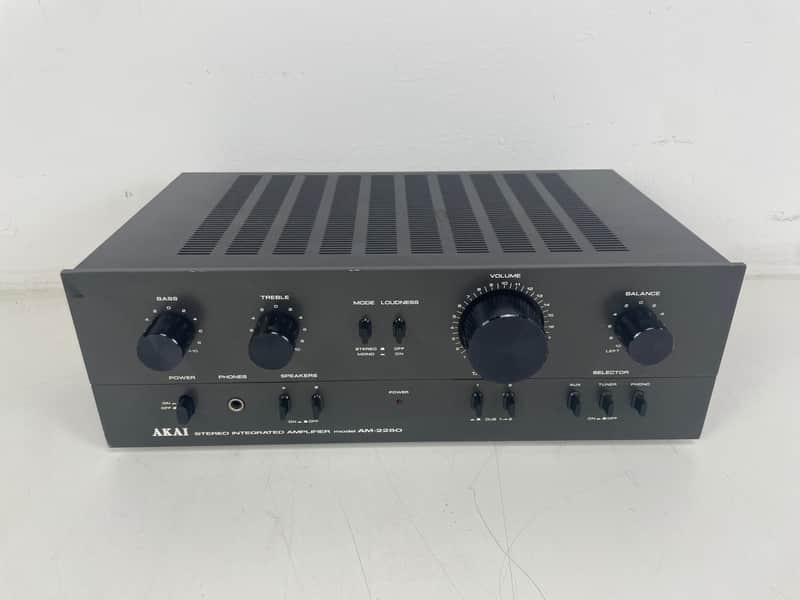
Akai AM-2250 Verstärker, Anthrazit

Technische Daten
• Dauerleistung (bei Klirrfaktor)
o 8 Ohm: 2x 25 W (20Hz - 20Khz)
o 4 Ohm:
• Dynamikleistung
o 8 Ohm:
o 4 Ohm:
• Frequenzgang:
o Phonoeingang: 30 Hz - 15.000 Hz +/- 1 dB
o AUX, Tuner, Tape: 10 Hz - 40.000 Hz +/- 1 dB
• Klirrfaktor: 50 dB
• Klangregelung:
o Bass: ± 9 dB bei 100 Hz
o Hochton: ± 9 dB bei 10 kHz
• Loudness: + 10 dB bei 100 Hz, + 6 dB bei 6 kHz

In hervorragendem Zustand, wie neu!
Funktioniert einwandfrei.

Ich bin hier als Privatperson unterwegs. Daher handelt es sich um einen Privatverkauf ohne Garantie, Gewährleistung oder Rücknahme

https://retronik.silicium.org/DOCUMENTS/Audiovideo/Akai/Akai-AM-2250-Owners-Manual.pdf

Our Thoughts RADAR AI

A tidy late-70s integrated like this is appealing if you want a straightforward vintage amp with phono onboard and sensible power for efficient speakers. At €189, it lands right on the median of the recent comparable listings, so the asking price looks fair rather than especially cheap or stretched.

That makes the buy case hinge on condition and completeness more than price. If it’s clean, fully working, and unmolested, the AM-2250 is a well-regarded little classic with enough character for vinyl and everyday listening, and fair pricing leaves room for a proper service if needed. For a unit like this, I’d want confirmed scratch-free controls, stable channel balance, and no signs of output-stage or power-supply issues before jumping in.

Independent perspective — not a price guarantee. Always verify condition, accessories and provenance before purchase.

About Akai

Akai Electric Company Ltd. traces its origins to Japan, founded by engineer Masukichi Akai in Tokyo around 1929, with his son Saburo Akai playing a key role in its early growth. Initially focused on affordable radio components, the firm formalized as a full electronics manufacturer post-World War II, often cited as 1946. By the mid-20th century, Akai had evolved into a prominent name in consumer audio, peaking in the 1970s before financial troubles led to its exit from the industry in 1991.

The brand built its legacy on high-quality tape-based audio gear, including reel-to-reel tape recorders, cassette decks, tuners, amplifiers, and complete stereo systems that brought professional-grade sound to homes. In the late 1980s, Akai Professional revolutionized music production with the MPC series—starting with the 1988 MPC60, co-designed by Roger Linn—integrating sampling, sequencing, and velocity-sensitive pads into compact workstations that defined hip-hop and electronic genres.

Today, Akai holds a revered vintage-collector status among hi-fi enthusiasts for its robust 1970s components, prized for their warm analog character and build quality. In the pro audio realm, the MPC line endures as an iconic, mid-to-high-end tool for beatmakers, with modern iterations sustaining the brand through licensing. While not a current leader in traditional hi-fi like amplifiers or speakers, its heritage appeals to savvy buyers seeking timeless reliability over fleeting trends.


See all Akai listings on RADAR.

More AM-2250 listings