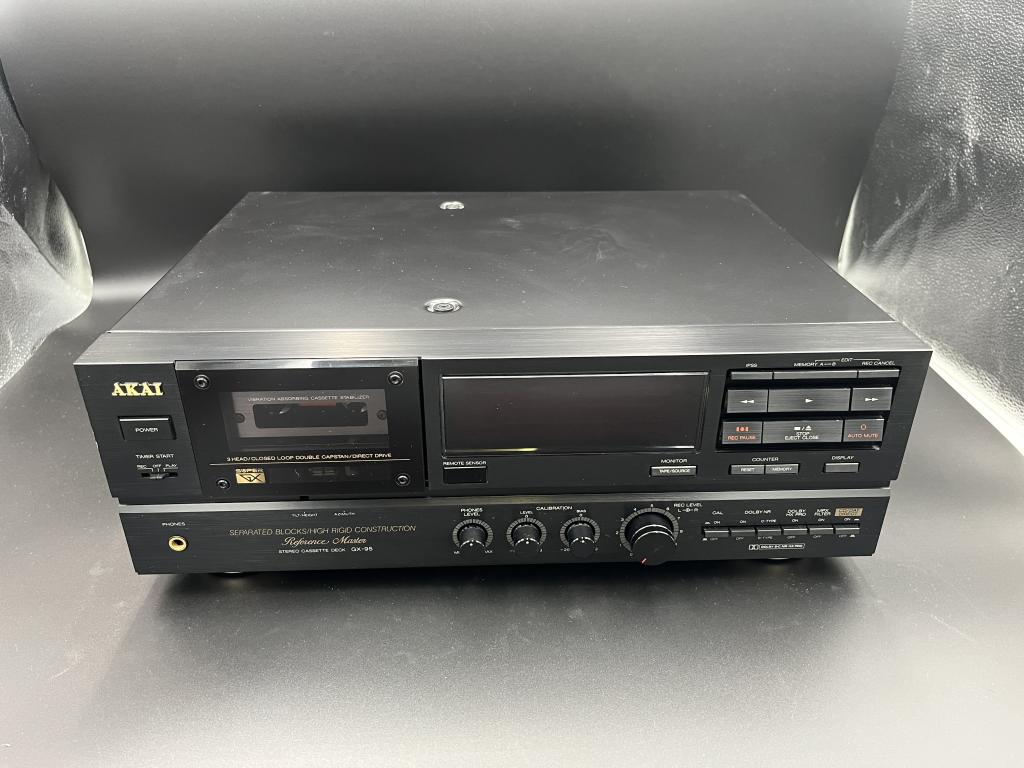
Akai GX 95
- Condition
- Good
- Location
- DE
- Source
- audio-markt.de
- Posted
- 7h ago
- Last seen
- 6h ago
RADAR is a price search engine. We link to the original listing — we never sell direct. Transactions happen on the source site.
Offered is „GX 95“ by Akai as second-hand device from the category „Tape Recorder“ on audio-markt.de - the online market place for high-end. The advert with the number 9721566323 ends on 14.12.2026 at 06:02 o'clock.
At €900, this GX-95 in “good” condition sits right at the median of the current used market, which ranges from roughly €350 for working units to €968 for clean examples, making the price fair rather than a bargain. It’s notably below the €1,100 asking price for a fully serviced GX-95 MKII, but since this is the original GX-95 (not the MKII), the €900 figure reflects solid value for a well-maintained deck without overpaying for recent service.
The GX-95 is a respected 3-head cassette deck from Akai’s high-end era, prized for its robust transport, low noise, and warm analog sound that rivals many Japanese decks of the 1980s. At this price, it’s a worthwhile buy if the “good” condition note implies clean belts, functional heads, and no mechanical drift—common concerns on decks of this age. If it’s original-owner with original accessories, the upside is even stronger, as these decks are increasingly rare in usable shape.
Independent perspective — not a price guarantee. Always verify condition, accessories and provenance before purchase.
Akai Electric Company Ltd. traces its origins to Japan, founded by engineer Masukichi Akai in Tokyo around 1929, with his son Saburo Akai playing a key role in its early growth. Initially focused on affordable radio components, the firm formalized as a full electronics manufacturer post-World War II, often cited as 1946. By the mid-20th century, Akai had evolved into a prominent name in consumer audio, peaking in the 1970s before financial troubles led to its exit from the industry in 1991.
The brand built its legacy on high-quality tape-based audio gear, including reel-to-reel tape recorders, cassette decks, tuners, amplifiers, and complete stereo systems that brought professional-grade sound to homes. In the late 1980s, Akai Professional revolutionized music production with the MPC series—starting with the 1988 MPC60, co-designed by Roger Linn—integrating sampling, sequencing, and velocity-sensitive pads into compact workstations that defined hip-hop and electronic genres.
Today, Akai holds a revered vintage-collector status among hi-fi enthusiasts for its robust 1970s components, prized for their warm analog character and build quality. In the pro audio realm, the MPC line endures as an iconic, mid-to-high-end tool for beatmakers, with modern iterations sustaining the brand through licensing. While not a current leader in traditional hi-fi like amplifiers or speakers, its heritage appeals to savvy buyers seeking timeless reliability over fleeting trends.

See all Akai listings on RADAR.