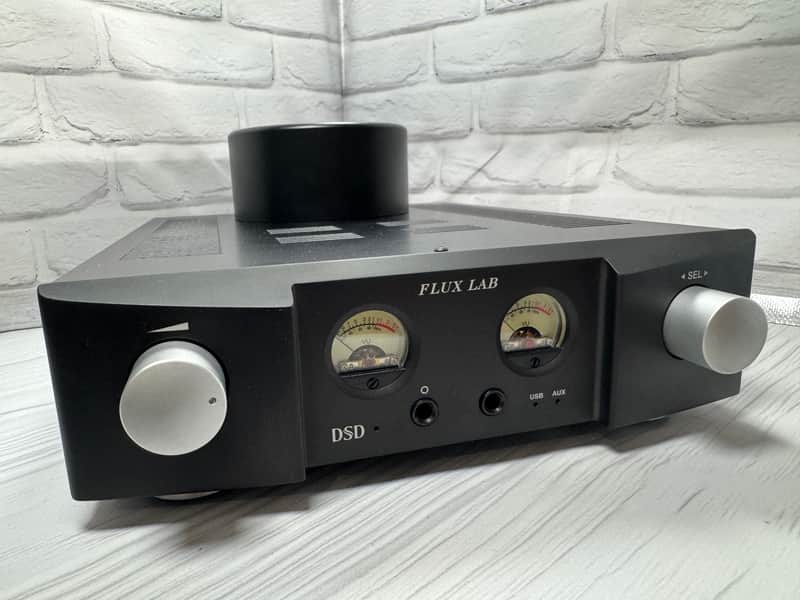
PREOWNED – FULLY TESTED – INCLUDES ORIGINAL BOX/PACKING, REMOTE, POWER CABLE, WIFI ANTENNA
Flux Atlas is the outcome of 10 years of experience designing High-End audio equipment and 2 years of continuous development of this model only. Happy to present our flagship DAC/preamp/headphone amplifier!
Smart ergonomics
This device is equipped with a touch screen, a digital encoder, a motorized volume control and an infrared port (used along with the remote control) to control all the functionality. The front panel is made of solid aluminium milled on a high-precision five-axis milling machine (SMC Machine)
Flexibility
Taking an attention wide number of digital interfaces on market and customers traction for an experiment Flux Atlas equipped with all necessary digital interfaces. To provide the best sound quality there are realised two separate outputs of the DAC and pre-amplifier, AUX input. Trigger out socket and micro-USB update port.
The Atlas digital-analog part is built using two best-in-class converters made by Asahi Kasei Microdevices – AK4497EQ. These converters have a lower level of non-linear distortion and have a noticeable superiority in dynamic range as compared to the previous generation. A dual mono circuit with one separate AK4497EQ chip per channel is used to ensure the maximum dynamic range and channel separation.
4 independent low-noise linear regulators are used for each chip including a separate core power supply taking into account the relatively high dependence of AK4497EQ on the power supply quality.
The power supply module circuitry includes capacitors of Fine Gold series manufactured by Nichicon and tailored to audio devices. The use of these capacitors allows you to get a clearer sound in the entire frequency range and, in particular, a magnificent low-frequency range.
The signal of each AK4497EQ is filtered by an individual low-pass filter (LPF) developed entirely on a discrete-component circuit. The choice of such a complex decision is conditioned by the fact that only the use of certain radio parts which cannot be located inside single-chip devices (an operating amplifier) makes it possible to obtain a noticeably better result. The LPF circuit uses resistors made by the Japanese company Takman Electronics which are designed for the use in audio devices. Installing them in a discrete-component circuit of LPF allowed us to obtain an exceptional level of naturality and softness of the sound which is challenging or even impossible to achieve using the “factory-made” metal-film resistors and most surface-mounted resistors (SMD).
Amanero Technologies software is used for integrated USB converter. It is arguably one of the best solutions for the output of a digital stream from USB in asynchronous mode. The USB connector is additionally isolated from the chassis of the device by means of an anti-short bushing. This minimizes the parasitic capacitive coupling between the USB connector that connects to the PC and the DAC case which is connected to the analog ground.
All digital signals at the output of the USB converter are galvanically isolated from the board on which the AK4497EQ digital-to-analog converters are installed. This solution prevents the transmission of digital noise from the PC and prevents the formation of a parasitic circuit (an “earth” loop). As a result, it is possible to get the maximally clear sound of the system in any situation.
Clocking the digital part is carried out from ultra-low-noise generators manufactured by Crystek Corporation – CCHD-575. It allows achieving exceptionally stable and accurate operation of the digital part of the DAC circuit.
Raspberry Network Core. The Flux Atlas can link wirelessly or directly to a router for network music playback. With, and wide protocol support for 32-Bit/192kHz and DSD128, the Flux Atlas can be also used without a computer to stream audio from any network device or USB-drive.
Being a true balanced circuit design the Flux Atlas built on a premium Japan Alps motorized rotary volume potentiometer with 4 tracks.
An Oyaide single-crystal copper cable made in Japan is used for internal analog wiring layout.
The preamplifier/headphone amplifier is built entirely on a basis of balanced layout for which four identical amplifier units are used. Amplifiers operate in deep class A that allows gently transmitting the smallest peculiarities when playing audio recordings.
The amplifier circuit has three basic amplification gain factor setting options (GAIN) for matching with headphones with various impedance and sensitivity.
Only high-quality connectors are used to connect external devices. RCA connectors are manufactured by CMC and AC-INLET Furutech. XLR and headphone 6.3mm outs made by Neutrik.
DAC
DAC Chip
Dual AK4497
Frequency Response
20Hz-20Khz, +/-0.1dB, 1Hz-100KHz, -1dB
Analog Output Voltage
Full scale converted 2.6V (RMS)
Output Resistance DAC
RCA 44Ohm
XLR 88Ohm
S/N
>128dB
Digital inputs
Balanced AES/EBU (110Ohm), 44.1 kHz to 192 kHz sampling and up to 24-bit.
Coax SPDIF input (75Ohm), 44.1 kHz to 192 kHz sampling and up to 24-bit.
BNC SPDIF input (75Ohm), 44.1 kHz to 192 kHz sampling and up to 24-bit.
Optical input (Toslink), 44.1 kHz to 96 kHz sampling and up to 24-bit.
USB 2.0 input (B type), up to 192 kHz sampling and up to 32-bit, DSD64, DSD128;
I2S LVDS input (HDMI), up to 768 kHz sampling and up to 32-bit, DSD64, DSD128, DSD256, DSD512;
LAN input, up to 192 kHz sampling and up to 32-bit, DSD64, DSD128;
DAC Analog outputs
balanced XLR
single-ended RCA
Preamp/HP Amplifier
Analog inputs
balanced XLR
single-ended RCA
Analog outputs
4-pin balanced female XLR headphone out
2x TRS headphone out
2x 3-pin female XLR headphone out
3-pin male XLR pream
single-ended RCA preamp
Frequency Response
1Hz-1.2MHz, -3dB
Output power
32Ohm: 2600mW RMS per channel
50Ohm: 1700mW RMS per channel
300Ohm: 360mW RMS per channel
THD
95dB, 20 Hz-20KHz
Output Impedance
0.1Ohm
Input Impedance
50KOhm
Gain
3.5dB, 15.1dB, 21.2dB, 23.9dB
Output Resistance Preamp
RCA 47Ohm
XLR 94Ohm
Power Consumption
50W
Dimensions
17 * 3.8 * 20.7 inch (43.2 * 9.6 * 52.7 cm)
Weight
24.2lbs (11.2kg)
Features
Trigger out: 12V 150mA DC
Micro USB update port
Wi-Fi IEEE 802.11, 2.4GHz