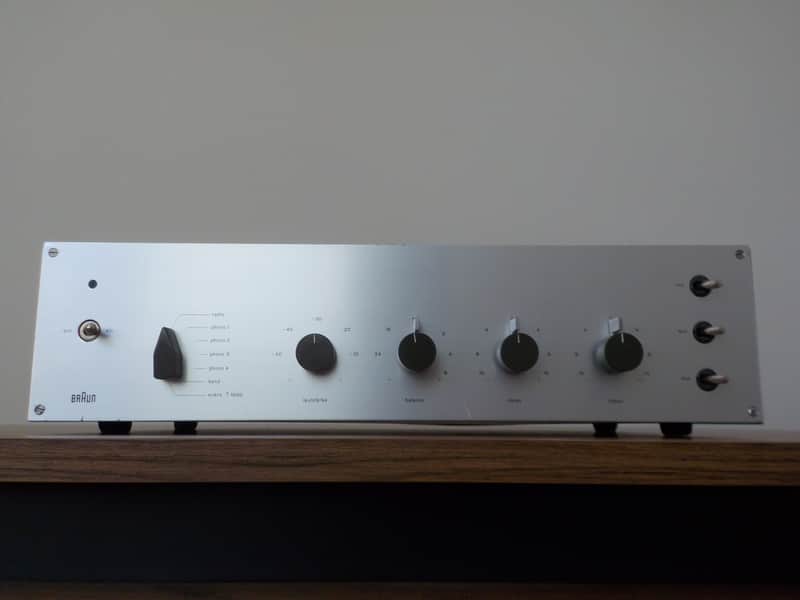
Braun CSV HiFi Dieter Rams
- Location
- US
- Source
- Reverb
- Posted
- 19 May 2026
- Last seen
- 3h ago
RADAR is a price search engine. We link to the original listing — we never sell direct. Transactions happen on the source site.
Please follow all the gear on my Facebook page "BestSound4U2-Musical Instrument Vintage", with all the information about the instrument + photos.If you have any specific questions, please contact (repaired parts, defects, marks, scratches).All instruments are delivered with up-to-date maintenance.Braun CSV 60 integrated hi-fi stereo amplifier, the brand's "top of the line". This model, with its aluminum finish, was manufactured between 1962 and 1966 and amplified the top-of-the-range LE1 speakers. The LE1s were Braun's electrostatic speakers, the result of a partnership with the British company QUAD, in which their wonderful ESL 57 speakers were supplied to Braun, who then "created" a new structure/cabinet according to their unique design and sold them in the German market as "Braun".It is a 60-watt stereo amplifier, 30 watts RMS per channel. The Braun has been updated to work with PL504 tubes, currently using two pairs of NOS tubes from Valvo. These tubes replaced the PL500 tubes on the market, being more efficient and approximately 20% more powerful. Let's say they work more "relaxed" than the original PL500s.This upgrade was only possible with an adjustment to the Braun BIOS, among other adjustments.In total, the amplifier has 10 tubes, divided as follows: Power, 4x PL504 and 2x ECF80, and in the Pre-amplification, 4x ECC83.For speaker connection, there is switching between 4, 8 and 15Ω. There is also a double switch on the back of the amplifier to select whether to connect two speakers or only one to the output.The original double electrolytic capacitors were replaced with new ones, also of German brand, in addition to a "recap" of dozens of coupling capacitors, replacement of trimmers, among others.In the speaker output, female banana plugs were added, replacing the outputs of the Braun LE1.This amplifier belongs to an emblematic era in World Design. At the time, through one of the most influential designers of the 20th century, the German industrial designer Dieter Rams, Braun became a cult and boutique brand for its design revolution, through the simplicity and beauty it imprinted on its products. This new "school" of design was developed in the 50s and 60s at the "Ulm School of Design" in Ulm, Germany. Rams became associated with the phrase "Weniger, aber besser", which means "less, but better". Nowadays, the design of Apple products at the beginning of this new millennium (design by Jonathan Ive, during Steve Jobs' period) is compared to creations strongly inspired by the products of Dieter Rams and Braun.In short, and without a doubt, it is an amplifier of enormous quality and fantastic design.
What makes this notable is the Dieter Rams-era Braun design rather than bargain-bin speaker pricing. At US$1,169, it sits above the 75th percentile of US$1,104 for recent comparable listings, so this is ambitious rather than fair-market; I’d want either exceptional originality or a notably complete, clean set to feel good at that number.
If the cabinet finish is honest, the drivers are original, and the crossover hasn’t been messed with, there’s real upside because these pieces are bought as much for industrial-design cachet as for sound. The appeal is strongest for a collector who values period-correct presentation and provenance; for a plain listening purchase, I’d want more price room, and I’d verify driver health, veneer condition, and whether any stands, badges, or matched-pair details are included before committing.
Independent perspective — not a price guarantee. Always verify condition, accessories and provenance before purchase.
Braun Audio traces its origins to 1921, when German engineer Max Braun founded the company in Frankfurt as a modest workshop producing radio components. By 1929, it had launched its own receivers, earning international acclaim at the 1937 Paris World Fair for sound engineering innovations. Post-World War II, Braun rebuilt with a sharp focus on high-fidelity reproduction, pioneering advancements under designer Dieter Rams from 1956 onward, including the first all-wave receiver, mobile music player (TP1 in 1959), stackable Hi-Fi systems, and wall-mounted integrated setups—many now museum pieces like those at MoMA.
The brand excelled in compact, modular stereo systems during the 1960s and 1970s, with iconic models like Audio 1, Audio 2, Audio 250, and Audio 300 featuring solid metal casings and uncompromised sound quality. Braun emphasized innovative portables, record players with plexiglass covers, and educational brochures on optimal listening setups, blending functionality with Rams' minimalist aesthetic across radios, phonographs, amplifiers, and early headphones.
Renowned among vintage collectors and design aficionados for its ahead-of-its-time hi-fi heritage, Braun Audio holds a niche position as a mid-tier icon of German engineering precision. After a 28-year hiatus, it relaunched in the 2010s under license, targeting enthusiasts who value timeless quality over cutting-edge exotica, with a current emphasis on preserving its storytelling legacy through curated webshops and reissues.

See all Braun Audio listings on RADAR.