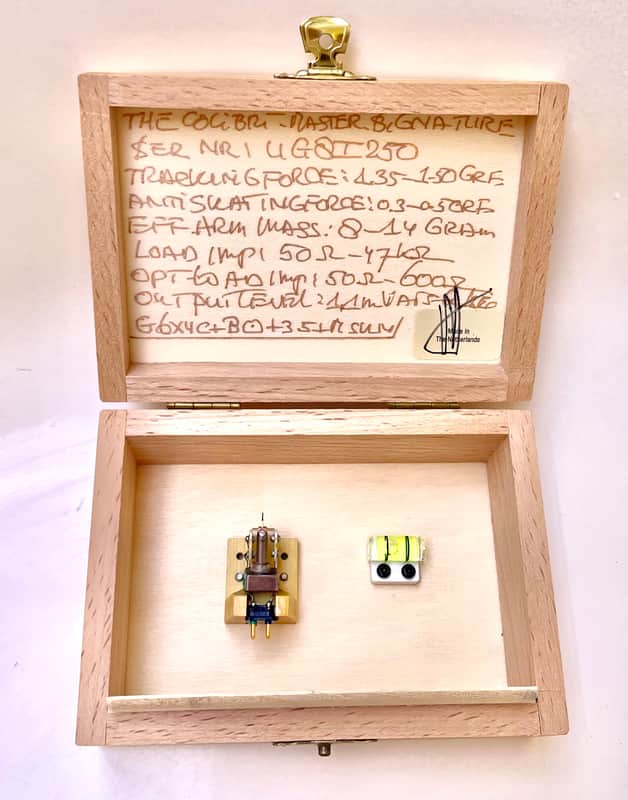
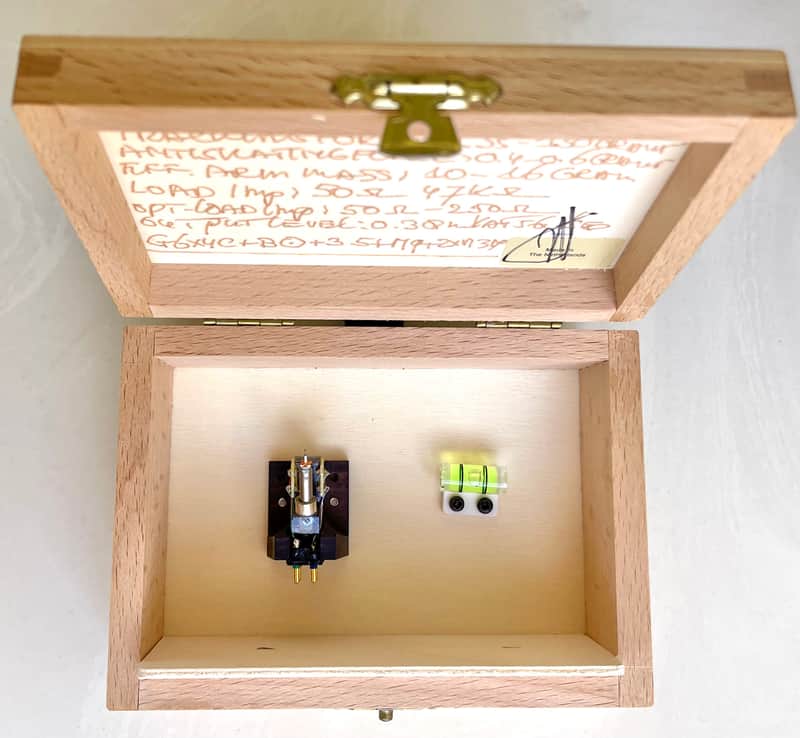
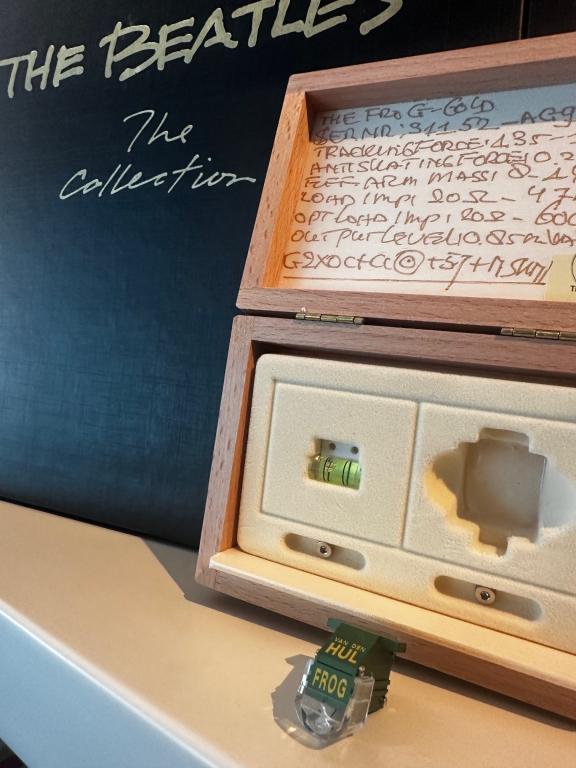
From my private collection:Van den Hul Colibri Master Signature Moving Coil Phono Cartridge.It was brand new when I got it a few years ago. I only tested it a few times to compare the sound with other cartridges, and I haven't used it for more than five hours in total.The sound quality is superb. If you want the best of the best, this is your chance to own it.The VDH Master Signature is the culmination of A.J. van den Hul’s 45 years of phono cartridge research and development. Due to a new magnetic structure, this is the highest output Colibri he has ever built. The coil weight is the same, with the same amount of turns in the coils. This provides more output, more dynamics, better staging and 40db separation between channels. The cantilever is 4 mm; a bit longer than the other Colibri models again for better dynamics and bass response. This cartridge has an unique high output of 1.1mV.Another extraordinary cartridge in the Colibri range of Van den Hul cartridges. This version is made from the Brazillian wood Pau Ferro which has been used for centuries by the most celebrated 17th century Italian violin makers particularly in bow making.Setting it apart from the Colibri XGW 'Stradavarius' is its extra magnet for even better resolution.It has the same hand-wound matched crystal gold coils as most of the Colibri range has.Keeping that effortless musicality but with even more resolution, a beautiful cartridge.Before the Colibri, the demand for high-end cartridges had pushed AJ van den Hul to design a high-end moving coil like the Grasshopper, but the Colibri (which takes its name from the Caribbean bird, one of the smallest in the world) represents a real break with the very idea of the MC cartridge as it was conceived until then: it is, in fact, a cartridge with a single pole instead of the traditional structure with front and rear poles, inside which the stylus is placed which must move symmetrically within the magnetic field to operate at its best.Thanks to his studies with the particle accelerator (van den Hul studied at the University of Deft) JA boasted a broad knowledge of the effects of magnetic fields (a know-how that also gave rise to his beliefs in medicine and alternative healing systems, but that's another story that perhaps we will tell in the future...): thus the lanky Dutchman had convinced himself that the harmful influence of the possible asymmetries that can be created when a generator is immersed in a double magnetic pole in a non-symmetrical way was such that eliminating one of the two poles could be a lesser evil. No sooner said than done, except that this significantly lowers the level of the generated signal (the first Colibris had an output voltage of just 0.26 mV), leading van den Hul to continually research more powerful magnets (now made of samarium cobalt) and more efficient coils: the first were made of copper, while the current ones are made of 24-karat gold with 20-25 micron braided wires. A path, from 1995 to today, has been characterized by progressive fine-tuning, primarily aimed at increasing the output voltage, which today, with the Master & Signature version, surprisingly reaches a value of 1.1 mV! Higher voltage means less need to stress the phono stage downstream (which needs to amplify less), with advantages in terms of background noise, which, van den Hul confides, is reduced to a minimum with the new version.Another advantage of the single-pole solution is that it's possible to create lower-mass cartridges and therefore pair them with low-mass tonearms while maintaining good trackability (even though JA's reference tonearm remains an SME V) and, above all, using shorter cantilevers (just 3.5 mm), a condition that guarantees, at least on paper, more accurate trackability. Solutions that, given van den Hul's predilection for naked cartridges, can be observed by examining the Colibri Master & Signature and its original appearance.The body has also changed in the new version of the head: the reddish Hawaiian acacia koa has been replaced by a much lighter Brazilian wood (van den Hul calls it whitewood). The body, crafted from solid wood using a CNC lathe, is coated with three to five coats of a lacquer whose formula is believed to date back 400 years, attributing it to Stradivari. It's unclear to what extent what was supposed to enhance the Cremonese luthier's splendid instruments' resonation, is likely instead intended to absorb vibrations and be inert here...!The varnish requires a long period between coats and an equally long final drying phase... The cantilever is made of boron as in previous models and the other elements (diamond cut and suspension system) are also proprietary ones developed by van den Hul and consistently used in his creations. As for the elastomer, also the result of a formula developed at the time by van den Hul, it is important to explain, in opposition to those who maintain that VDH cartridges are different from each other due to the artisanal nature of their construction (the body certainly does not, since it is industrially produced, although VHD makes no secret of this: "The same shape does not mean the same density, of course, which depends on the type and direction of the wood grain" ), that when the success of the CD seemed to completely overshadow analog, JA decided to buy up this material (and cantilevers too), investing the entire family fortune, convinced of the rebirth of vinyl and that that stock would come in handy.“Before the CD, every company involved in vinyl had its own specialist in damping materials; today these skills have disappeared” . In fact, although we are witnessing a revival of analog, the most conservative and least developed sector is precisely that of cartridges and for this reason JA jealously guards large quantities of that cryogenically frozen rubber and rations them, using them exclusively in the Colibri series cartridges!The magnetic field is concentrated along a conveyor placed close to the microcoils attached to the cantilever. Without the use of the opposite magnetic pole, the concentration is not among the highest, and for this reason the coils must have a greater number of turns while minimizing internal resistance. This involves a long series of parameters, all at the structural limit, which, however, together have created a one-of-a-kind product. The wiring is gold, extremely thin to minimize mass but also highly conductive. The upper holes are threaded, which greatly simplifies installation and simultaneously isolates the cartridge from high-frequency resonant transmission.Listening to the cartridge is truly sublime, a hymn to analog that confirms its top quality comparable to the best Hi-Res files but with a heart, a warmth unknown to them. This is the element that immediately catches the eye, but as the listening progresses, some further aspects begin to emerge. The impulse response, for example, is very fast yet smooth, almost as if to characterize a specificity of analog listening and to provide an extremely realistic sound representation without "special effects." The reproduction across the entire frequency spectrum is of the highest level, but the high portion is a record-breaker, giving voices (especially female ones) an unexpected pleasantness (like discovering that record for the first time). The soundstage is broad and of the highest level, but what is most striking is that within the virtual stage everything happens with record-breaking naturalness. Everything is beautiful, absolutely stunning, top marks, as is the price, which is over 10,000 euros. A real beast? A slap in the face of poverty? The production times, though still done using artisanal methods, are long, but the pleasure is state-of-the-art. So, judge for yourself...Specification:Different body types- W (W=wooden body), -P (Carbon plastic body), -M (Metal body, -A (Amber body)Matched crystal gold wire coilsStylus shape- VDH - 1SStylus radius- 2 x 85 MicronStylus tip mass- 0.24 MilligramVertical tracking angle- 22 DegreesFrequency range- 5 - 65.000 HzChannel unbalance- < 0.5 dBChannel separation- > 35 / > 30 dBTracking Force between 1.35 - 1.50 gramsTracking ability- 70 MicronAnti-skating Force between 0.0 - .6 gramsEffective Arm Mass of 1.0 - 1.6 gramsLoad Impedance: 50 ohms to 47K ohmsLoad capacitance- Non criticalStatic compliance- 35 Micron/mN see extra info (*3)Dynamic compliance- 20 Micron/mNOptimal Loading: 50 ohms to 600 ohmsOutput Level 1.1mV/channelWeight: 8.75gmOriginal price: $11995.This cartridge comes with original wood box, screws and bubble level.I have sold a lot of cartridges and got a lot of good feedback, please check them out.We guarantee that we will not sell cartridges that are not perfect, if you find that it is not suitable for you after receiving it. We have a full refund policy and you can return it, if you are not satisfied.And please take a look my other items.Thanks,WayneWayne's Audio