High End Tape Akai
- Condition
- Excellent
- Location
- Saarland, DE
- Source
- Kleinanzeigen
- Posted
- 3h ago
- Last seen
- 3h ago
RADAR is a price search engine. We link to the original listing — we never sell direct. Transactions happen on the source site.
Vintage!
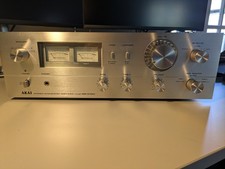
Akai GX-75 high End Tape
(Anzeige ist ein Report, Zugang zum alten Konto verloren)
Holz Seitenteile
Fernbedienung
Im Lieferumfang enthalten sind:
Akai GX-75 Bandmaschine
Bedienungsanleitung (in gedruckter Form)
Frequenzgangkurven bzw. Einmessprotokoll (in gedruckter Form).
Technische Daten
Modell: GX-75
Typ: Kassetten Tape Deck
Baujahre: 1988 – 1990
Hergestellt in: Japan
Farbe: Schwarz
Fernbedienung: optional (RC-G95)
Abmessungen: 425 x 154 x 350 mm (BxHxT)
Gewicht: 9,2 kg
Anschlüsse
Anzahl der Eingänge:LINE: 70 mV / 47 kOhm
CD/DAT DIRECT IN: 240 mV / 47 kOhm
Anzahl der Ausgänge:LINE: 388 mV / 150 kOhm
Kopfhörer: 1,3 mV (8 Ohm)
Technische Daten
Tonköpfe:1x LC-OFC Super GX-Tonkopf für die Wiedergabe
1x LC-OFC Super GX-Tonkopf für die Aufnahme
1x Löschkopf
Motoren:1x FG Servo DD elektronisch geschwindigkeitsgesteuert Gleichstrommotor für Antriebswellen-Antrieb
1x Gleichstrommotor für Spulenantrieb
1x Gleichstrommotor für Nockenantrieb und für Bandauswurf/Laden
Gleichlaufschwankungen: 0,025% WRMS, 0,04% (DIN)
Bandarten: Normal, CrO₂ und Metall
Frequenzgang:Normal: 20 bis 19.000 Hz ±3dB
CrO₂: 20 bis 20.000 Hz ±3dB
Metall: 20 bis 21.000 Hz ±3dB
Klirrfaktor: < 0,6 % (bei Metall)
Signalrauschabstand:59 dB (über Band mit Aufnahmespitzenpegel gemessen)
Dolby™ NR Type B eingeschaltet: verbessert um 5 dB bei 1 kHz, 10 dB über 5 kHz
Dolby™ NR Type C eingeschaltet: verbessert um 15 dB bei 500 Hz, 20 dB bei 1 kHz bis 10 kHz
Auto-Reverse: nein
Titelsuchlauf: 16 Titel mit IPSS-Funktion
Dolby™: B, C und HX PRO
MPX-Filter: ja
Fader: nein
Pitch-Kontrolle:
CD-Synchro-Aufnahme: nein
Besondere Ausstattungen
3-Tonkopf-System, Super GX-Tonköpfe, die LC-OFC (Linear Kristall/sauerstofffreies Kupfer) beinhalten
Mikroprozessorgesteuertes Laufwerk mit „Power-Eject“ und extrem leiser Mechanik
Closed Loop-Doppel-Capstanwellensystem durch Direktantrieb
Stabiler Bandtransportmechanismus mit breiten Bandführungen
Automatisches Monitorsystem
System zur automatischen Bandstraffung
Teillöschsystem
Nützliches Aufnahmestornierungs- und Stummschaltungssystem
Funktion zur wiederholten Wiedergabe eines Abschnittes zwischen 2 Punkten
Große konzentrierte FL-Anzeige mit Anzeige Ein/Aus Funktion zur Verminderung von unerwünschten Geräuschen
Spitzenpegelmesser mit Peak-Hold-System
Aufnahmeeichungssystem mit Vormagnetisierung und Pegelreglern
Separate Blockkonstruktion
Hochstabiles Design
Fernsteuerbar mit optionaler Fernbedienung (RC-G95)
Timer-Start-Funktion
Leicht bedienbarer Aufnahmepegelregler mit großem Durchmesser
Digitales Zeit-/Bandzählwerk
Zählwerkspeicher-Stoppsystem
Automatisches Wiedergabesystem
16 Titel IPSS-System
Aufnahmepegel-Hinweissystem
Unabhängiger Schalter für Multiplex-Filter
Schalter und Eingangsbuchsen für CD/DAT-Direct
Kopfhörerbuchse und Pegelregler
Automatisches Bandsortenwahlsystem
Fast neuwertiger Zustand selten benutzt, technisch einwandfrei!
Generating expert take…
Akai Electric Company Ltd. traces its origins to Japan, founded by engineer Masukichi Akai in Tokyo around 1929, with his son Saburo Akai playing a key role in its early growth. Initially focused on affordable radio components, the firm formalized as a full electronics manufacturer post-World War II, often cited as 1946. By the mid-20th century, Akai had evolved into a prominent name in consumer audio, peaking in the 1970s before financial troubles led to its exit from the industry in 1991.
The brand built its legacy on high-quality tape-based audio gear, including reel-to-reel tape recorders, cassette decks, tuners, amplifiers, and complete stereo systems that brought professional-grade sound to homes. In the late 1980s, Akai Professional revolutionized music production with the MPC series—starting with the 1988 MPC60, co-designed by Roger Linn—integrating sampling, sequencing, and velocity-sensitive pads into compact workstations that defined hip-hop and electronic genres.
Today, Akai holds a revered vintage-collector status among hi-fi enthusiasts for its robust 1970s components, prized for their warm analog character and build quality. In the pro audio realm, the MPC line endures as an iconic, mid-to-high-end tool for beatmakers, with modern iterations sustaining the brand through licensing. While not a current leader in traditional hi-fi like amplifiers or speakers, its heritage appeals to savvy buyers seeking timeless reliability over fleeting trends.

See all Akai listings on RADAR.