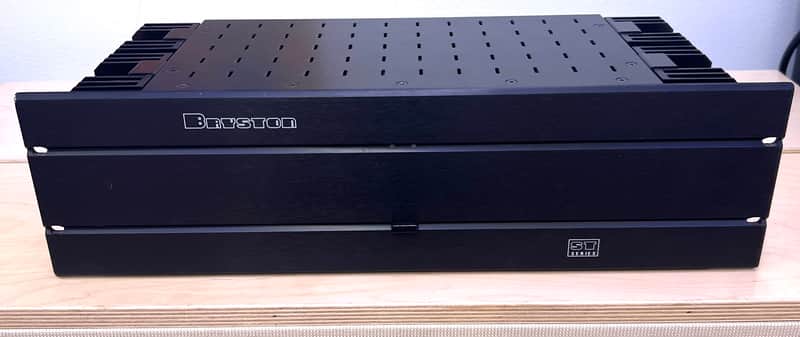
You're looking at a perfectly working audiophile grade power amp for your Hi-Fi system or recording studio!Pulled from a recording studio where no smoking is allowed. SOUNDS AMAZING!!!! I had this paired with a fresh set of NS-10s and fell in love with the imaging and detail. Literally delicious. One of the heat sinks is dented, hence the price drop, but this doesn't affect the sound at all. Just my asking price!Here's a review: Bryston 3B-STThe 3B-ST is a solid-state stereo power amplifier with an output stage running in class-AB2. Its 22-lb weight, diminutive chassis, and slim faceplate profile belie its 120Wpc power rating. While the entire chassis is used as a heatsink, the 3B-ST maintains Bryston's black, finned, rack-mount style. In fact, one could stack the 3B-ST, the 4B-ST, and the 7B-ST, and they would appear very similar from a distance. Similar interior design approaches are also used for the 3B-ST and 7B-ST.The 3B-ST's front panel is a ¼" sculpted, rack-sized piece of aluminum inscribed with two narrow horizontal grooves (the two front handles are similarly grooved). This single piece of extruded metal is buff-finished with a fine abrasive like jeweler's rouge; the resulting surface is so smooth that a finger rubbing the surface leaves no mark. The only lettering besides the company name is the "ST" logo. Otherwise, there are two tricolor LED power indicators, one per channel. These remain green while the unit is powered, turning yellow at the clipping threshold, red for clipping or internal fault. The clip-sensing circuit uses a comparator to detect the source of signal distortion, including clipping, short circuits in cabling, and excessive DC or supersonic signals. The brief instructional notes indicate that it's normal for the individual right and left LEDs to decay at different rates. The square Power pushbutton is the only front-panel control.The back panel has a complete set of inputs and switches. Each connector or switch is surrounded by clearly labeled instructions in white lacquer, in English and French. This makes it possible to set up the amplifier without having to locate the written instruction sheet. From left to right along the back panel are the following features: first, a detachable AC connector with a removable fuse holder containing two 250V, 4A fuses, one for each channel. A "Ground Lift" toggle switch is connected between the chassis ground (including the power cord's third prong) and the signal ground. Occasionally a grounding situation with another component, such as a preamplifier or another amplifier also equipped with a three-pronged grounded line cord, will cause a 60Hz hum from a ground loop set up between signal and chassis ground. Switching the Ground Lift into the up, or open, position reduces 60Hz hum without resorting to a cheater plug. This proved useful in my system, with its 45' of single-ended interconnect runs between preamplifier and crossover.The 3B-ST's output connectors consist of two pairs of gold-plated, 5-way binding-posts. For bridged operation, the two amplifier sections are operated with one channel inverted to form a single push-pull amplifier with double the output voltage. Only the left unbalanced or balanced input is used in the bridged mode. The slide switch for switching between stereo and bridged operation can be found just to the right of the output terminals. All Bryston amplifiers are equipped with three pairs of input connectors: a pair of unbalanced RCA jacks, a pair of balanced XLRs (pin 2 positive), and a pair of ¼" phone jacks (tip positive).Opening a Bryston product requires a Roscoe S-1 square-recess screwdriver to turn the machine screws that fasten the top panel. These screws are snugly fitted into the chassis's threaded steel inserts by means of a locking thread-sealer, which lowers vibration and increases structural stability. The 3B-ST uses gold-plated board-edge connectors on driver and input boards. Soldered and other gas-tight mechanical connections are used for signal circuits. Circuit boards are very-high-quality double-sided epoxy-glass, with component-designator screening.All Bryston amplifiers get a rugged 100-hour factory burn-in consisting of a squarewave input signal driving the amplifier into a capacitive load, slightly under clipping. Unlike a resistive load, which dissipates all the energy as heat, a capacitive load feeds back the entire signal into the amplifier, which puts maximal thermal stress on the output stages. After burn-in, each 3B is again tested; the results are shipped with the amplifier.Except for the single power cord and the back-panel bridging-circuit board, the 3B-ST is a true dual-mono design. Two 225 VA toroidal transformers are located just behind the front panel. It has separate ±55V power supplies with four 4700µF smoothing electrolytics for each channel. Short leads bring these filter caps to within 1" of the output circuitry.The 3B-ST's power supply is "stiff" in that it is relatively unaffected by a big current draw: whether the amp is idling or at full-power current draw, the rail voltage will not sag by much. Holes have been drilled into the heatsink recesses in the chassis sides to allow unimpeded airflow, even if the amplifier is placed on a carpet. The slow-start circuitry introduced in the NRB line, added to avoid line surges when the amp is turned on, has been continued in the ST series.Listening to the 3B-STAfter reviewing a steady stream of massive audiophile power amplifiers, the relatively tiny, lightweight Bryston 3B-ST spelled relief. During the review I placed it atop a Mark Levinson No.331. Rated at the same power as the Bryston, the '331 is four times as expensive, almost six times as heavy, twice as deep, and almost twice as tall! For someone used to doing the audiophile amplifier lift drill—deep breath, bend at the knees, lift straight up to protect the back—moving the 3B-ST's mere 20 lbs around was pure joy.Yet the tiny 3B-ST packs plenty of power for a lightweight? bantamweight. The Dahlquist DQ-10s gave visual evidence of this punch and kick when I played a Bob Marley medley at a healthy volume in my smaller listening room. Although the music was cooking with no obvious distortion, the surrounds on both speakers' 20-year-old woofers disintegrated on one drumkit crescendo, spraying the dust from dried and hardened rubber rim supports into the room. Peter Madnick of Audio Alchemy put me in touch with Miller Audio, who re-coned the woofers. Upon their return, the Bryston 3B-ST and DQ-10s played the Marley tune louder; this time the woofers remained intact.The notes for my first listen to the Bryston 3B-ST on the Snell Reference Towers reported on this speed and power. Like the 4B-NRB I reviewed several years ago, the 3B-ST's strengths are in the power regions of the audio spectrum: midbass and bass. The 3B-ST delivers fast, powerful, well-defined bass with depth, extension, and solidity. It combines "snap" and "slam," allowing the listener to perceive both the low-frequency energy and the tightness and definition to the leading edge of the bass pulse. These qualities make it the equal of the No.331 in dynamics and speed.However, the very revealing Snell Reference A system also revealed mild sonic differences between the Bryston 3B-ST and Levinson amplifiers. While the 3B-ST seemed more forward in the midrange, the Levinson sounded smoother and sweeter, with a more open top end. Choral pieces had more dimensionality on the No.331, with a wider and deeper soundstage.However, the 3B-ST's dynamics and punch made it a very good match for smaller dynamic loudspeakers such as the Totem Model 1s when playing vocal, clarinet, and piano selections. Over the Totems both the 3B-ST and No.331 did admirable jobs of delineating voices and instruments and accurately depicting their spatial positions. The lead singer's voice on the first Blue Nile LP (A Walk Across the Rooftops, Linn LKH1) has a full, three-dimensional quality and warmth quite separate from the music and special effects. Suzanne Vega's startling acappella "Tom's Diner" (on her Solitude Standing CD, A&M 5136) was lifelike and three-dimensional through both amplifiers.As an upper-range amp, the Bryston 3B-ST was clean, fast, and very dynamic, but not as transparent as the No.331. The Levinson pulled ahead in reproducing the silvery sheen on cymbals in Jeff Beck's "Behind the Veil." On Richard Thompson's "I Misunderstood" (from Rumor and Sigh, Capitol CDP 7 95713 2), the 3B-ST revealed such midrange nuances as Thompson's plosive accent on the last consonant of every line. The Bryston 3B-ST also allowed me to hear the layering of textures in the mix on this CD. The No.331's slight brightness, on the other hand, woke the somewhat reticent Quads to give more depth to the sonic portrait.My listening notes and sessions, then, reveal the Bryston 3B-ST to be not only a surprisingly powerful amplifier with strong dynamics, but also the equal of more expensive solid-state amplifiers in its ability to deliver powerful bass, wide dynamic contrasts, and involving vocal reproduction. Only in the areas of imaging and soundstaging did amplifiers costing more than four times as much begin to pull ahead of the 3B-ST.Sonically, it resembles the NRB Brystons, specifically in the areas of bass and midrange dynamics, punch, and solidity, where it equals top amplifiers like the Classé 15 and the Mark Levinson No.331. (These much-more-expensive amplifiers, however, better the 3B-ST in transparency, hi